




What is the transient response of an analog laser diode?
 Oct 24, 2025|
 As a supplier of analog laser diodes, I often encounter customers who are curious about the transient response of these essential components. In this blog post, I'll delve into what the transient response of an analog laser diode is, why it matters, and how it impacts various applications.
Understanding the Basics of Analog Laser Diodes
Before we dive into the transient response, let's briefly review what an analog laser diode is. An analog laser diode is a semiconductor device that emits coherent light when an electric current is applied. Unlike digital laser diodes, which operate in an on - off mode, analog laser diodes can vary the intensity of the emitted light continuously. This property makes them suitable for applications such as optical communication, sensing, and spectroscopy.
What is Transient Response?
The transient response of an analog laser diode refers to its behavior during the transition from one operating state to another. When a sudden change occurs in the input current, the output light intensity of the laser diode does not immediately reach its new steady - state value. Instead, it goes through a transient period, during which the light intensity changes over time.
This transient behavior is characterized by several key parameters. One of the most important is the rise time, which is the time it takes for the light intensity to increase from a specified low value (usually 10% of the final value) to a specified high value (usually 90% of the final value). Similarly, the fall time is the time it takes for the light intensity to decrease from 90% to 10% of the initial value when the input current is reduced.
Another parameter is the overshoot, which is the maximum value of the light intensity that exceeds the final steady - state value during the transient period. Undershoot, on the other hand, is the minimum value of the light intensity that falls below the final steady - state value.
Factors Affecting Transient Response
Several factors can influence the transient response of an analog laser diode. One of the primary factors is the parasitic elements in the laser diode and its driving circuit. Parasitic capacitance and inductance can cause delays and oscillations in the current flow, which in turn affect the light output. For example, a large parasitic capacitance can slow down the rise and fall times of the light intensity.
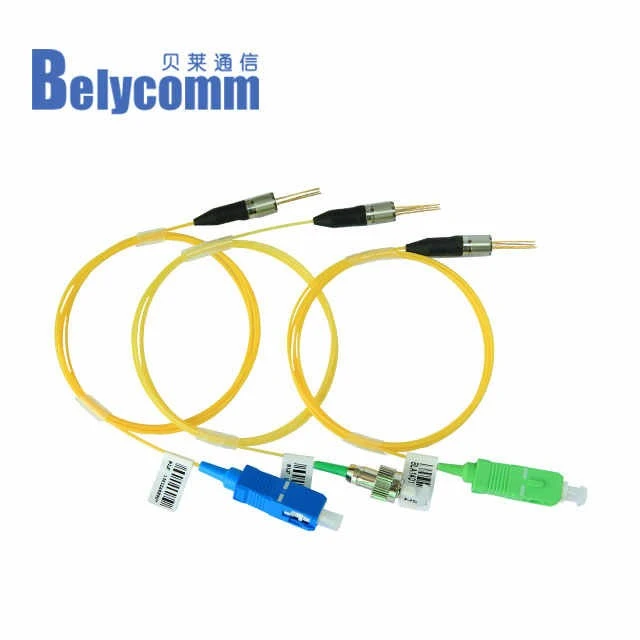

The internal physical processes within the laser diode also play a crucial role. The carrier dynamics, such as the injection, recombination, and diffusion of charge carriers, determine how quickly the laser can respond to changes in the input current. Additionally, the temperature of the laser diode can have a significant impact on its transient response. Higher temperatures can increase the carrier recombination rate, which may lead to faster but less stable transient behavior.
Importance of Transient Response in Applications
The transient response of an analog laser diode is of great importance in many applications. In optical communication systems, for instance, a fast and stable transient response is essential for high - speed data transmission. A slow rise or fall time can cause inter - symbol interference, where the symbols in a data stream overlap, leading to errors in data reception. The overshoot and undershoot can also cause signal distortion, reducing the signal - to - noise ratio and degrading the overall performance of the communication system.
In sensing applications, such as laser rangefinders and optical encoders, the transient response affects the accuracy and speed of the measurement. A fast transient response allows for more rapid and precise detection of changes in the measured parameter, enabling real - time monitoring and control.
Our Product Offerings and Transient Response
At our company, we understand the critical role of transient response in the performance of analog laser diodes. That's why we offer a range of high - quality products with excellent transient response characteristics. Our 2.5G 1270 - 1610nm CWDM DFB Laser is designed to provide fast and stable transient response, making it ideal for high - speed optical communication applications. With low rise and fall times and minimal overshoot and undershoot, this laser diode ensures reliable data transmission even at high data rates.
Our Analog 10G CWDM DFB Laser is another product that offers superior transient response. It is specifically engineered to meet the demanding requirements of 10G optical communication systems, providing high - speed and accurate signal transmission.
In addition, our Digital 2.5G DFB - LD Laser also has well - controlled transient behavior, ensuring reliable performance in digital communication applications.
Testing and Characterization of Transient Response
To ensure the quality and performance of our analog laser diodes, we conduct rigorous testing and characterization of the transient response. We use advanced measurement techniques and equipment to accurately measure the rise time, fall time, overshoot, and undershoot. Our testing procedures are designed to simulate real - world operating conditions, allowing us to verify the performance of our products under various scenarios.
Conclusion and Call to Action
In conclusion, the transient response of an analog laser diode is a critical parameter that affects its performance in a wide range of applications. Understanding the transient behavior and its influencing factors is essential for selecting the right laser diode for your specific needs.
If you are in the market for high - quality analog laser diodes with excellent transient response, we invite you to contact us for more information and to discuss your procurement requirements. Our team of experts is ready to assist you in finding the best solutions for your applications.
References
- "Optical Fiber Communications" by Gerd Keiser
- "Semiconductor Laser Diodes: Fundamentals and Applications" by Joachim Piprek