




How to control the beam divergence of an analog laser diode?
 Jan 09, 2026|
 As a supplier of analog laser diodes, I've seen firsthand how crucial beam divergence control is in various applications. Beam divergence can significantly impact the performance of a laser system, affecting everything from the range of a laser pointer to the precision of a fiber optic communication network. In this blog, I'll share some practical tips on how to control the beam divergence of an analog laser diode.
Understanding Beam Divergence
Before we dive into the control methods, let's quickly understand what beam divergence is. Beam divergence refers to the angle at which a laser beam spreads out as it travels away from the laser source. It's usually measured in milliradians (mrad) or degrees. A lower beam divergence means the beam stays more focused over a longer distance, which is often desirable in many applications.
The divergence of a laser beam is inherent to the design of the laser diode and is influenced by factors like the size of the laser cavity and the properties of the laser material. Understanding these factors can help us find ways to control the beam divergence.
Choosing the Right Laser Diode
The first step in controlling beam divergence is selecting the right analog laser diode for your application. Different laser diodes have different inherent beam divergence characteristics. For instance, multi - mode laser diodes generally have a higher beam divergence compared to single - mode laser diodes.
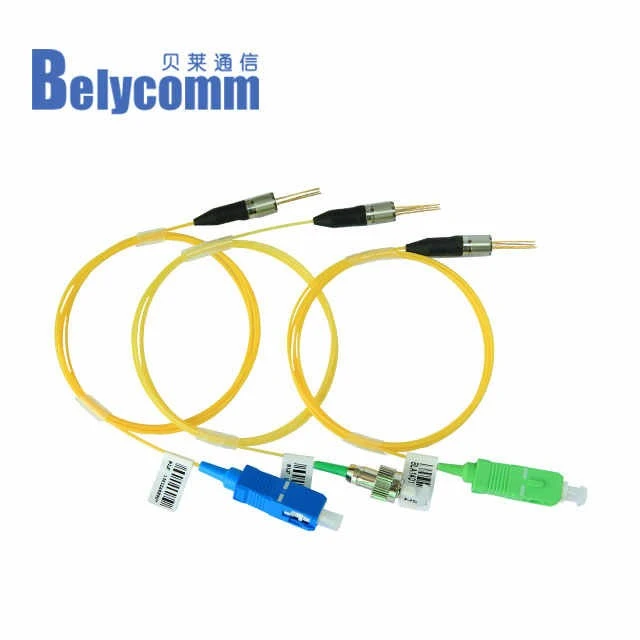
If you need a laser beam with low divergence, single - mode laser diodes are a great option. They have a small emission area, which results in a more collimated beam. At our company, we offer a range of high - quality single - mode analog laser diodes, such as the Analog 10G CWDM DFB Laser and the 2.5G 1270 - 1610nm CWDM DFB Laser. These diodes are designed to provide a relatively low - divergence beam, making them suitable for applications that require long - range or high - precision performance.
Using Beam Shaping Optics
Once you've selected the right laser diode, the next step is to use beam shaping optics to control the beam divergence. One of the most common optics used for this purpose is a collimating lens. A collimating lens takes the diverging laser beam from the diode and makes it parallel. This effectively reduces the beam divergence, allowing the beam to travel further without spreading out too much.
There are different types of collimating lenses available, such as spherical lenses and aspherical lenses. Aspherical lenses are often preferred because they can correct for spherical aberration, which is a common issue in spherical lenses. This results in a more focused and less divergent beam.

Another type of beam shaping optic is a beam expander. A beam expander increases the diameter of the laser beam while reducing its divergence. It consists of two or more lenses arranged in a specific configuration. By increasing the beam diameter, the angle of divergence decreases according to the laws of optics.
Temperature Control
Temperature can also have a significant impact on the beam divergence of an analog laser diode. As the temperature of the laser diode increases, the refractive index of the laser material changes, which can cause the beam divergence to increase. This is known as thermo - optical effect.
To control the beam divergence, it's important to maintain a stable temperature for the laser diode. This can be achieved using a thermoelectric cooler (TEC). A TEC can either heat or cool the laser diode depending on the temperature requirements. By keeping the temperature constant, you can ensure that the beam divergence remains stable over time.
Drive Current Control
The drive current supplied to the laser diode can also affect the beam divergence. When the drive current is too high, the laser diode can operate in a multi - mode regime, which increases the beam divergence. On the other hand, if the drive current is too low, the laser may not lase properly or may have a very low output power.
To optimize the beam divergence, it's important to find the right drive current for your laser diode. This usually involves some experimentation and testing. You should also ensure that the power supply used to drive the laser diode is stable and free from electrical noise, as fluctuations in the drive current can cause variations in the beam divergence.
Alignment and Mounting
Proper alignment and mounting of the laser diode and the beam shaping optics are crucial for controlling the beam divergence. If the laser diode is not properly aligned with the collimating lens or other optics, it can result in an asymmetric beam and increased divergence.
When mounting the laser diode, you should use a stable and rigid mount to prevent any vibrations or movements that could affect the alignment. The optics should also be carefully aligned to ensure that the beam passes through them in a straight and centered manner.
Monitoring and Feedback
Finally, continuous monitoring and feedback can help you maintain optimal beam divergence. You can use a beam profiler to measure the characteristics of the laser beam, including the beam divergence. By regularly monitoring the beam divergence, you can detect any changes or anomalies early on and take corrective actions.
You can also implement a feedback control system that adjusts the drive current, temperature, or other parameters based on the measured beam divergence. This can help ensure that the beam divergence remains within the desired range over long periods of operation.
Conclusion
Controlling the beam divergence of an analog laser diode is a multi - faceted process that involves choosing the right laser diode, using beam shaping optics, controlling temperature and drive current, proper alignment and mounting, and continuous monitoring. By following these steps, you can optimize the performance of your laser system and achieve the desired beam characteristics.
If you're in the market for high - quality analog laser diodes or need more information on beam divergence control, don't hesitate to reach out. We're here to help you find the best solutions for your specific application. Whether you need a Analog 10G CWDM DFB Laser, 2.5G 1270 - 1610nm CWDM DFB Laser, or Digital 2.5G DFB - LD Laser, we've got you covered. Contact us today to start a conversation about your procurement needs.
References
- Saleh, B. E. A., & Teich, M. C. (2007). Fundamentals of Photonics. Wiley.
- Koechner, W. (2006). Solid - State Laser Engineering. Springer.